The Milesian Dawn of Western Philosophy
Anaximander articulated the first systematic cosmology grounded in rational observation rather than mythological projection. He introduced a primordial ontochronology where the very existence of beings remains inextricably tethered to the assessment of time. The Milesian thinker viewed the world not as a collection of static objects but as a field where finite things pay penalty to one another for the injustice of their individuation. This singular surviving fragment delineates a metaphysical system where time functions as a judge over the coming-to-be and passing-away of all entities. The radical nature of this vision remained dormant until nineteenth and twentieth-century thinkers sought to bypass the Socratic tradition to recover this pre-metaphysical clarity.
Friedrich Nietzsche located in Anaximander a pre-Socratic hardness that stood in opposition to the optimistic rationalism defining later Western thought. He argued that philosophy reached its zenith with the Milesian ontologists who perceived existence as a tragic necessity governed by strict cosmic laws. For Nietzsche, the Anaximander fragment reveals a judicial economy where the emergence of individual forms constitutes a crime against the primal unity. This transgression demands expiation through the eventual destruction of the individual, transforming the life cycle into a process of incurring and repaying ontological debt. Nietzsche viewed this interpretation as a counter-argument to the effeminizing influence of logical dialectics that sought to explain away the suffering of life. His reading establishes Anaximander as the source of a tragic wisdom that later philosophical schools systematically suppressed to comfort the human subject.
Heidegger expanded this inquiry in his 1946 analysis by framing Anaximander as the thinker of the ontological difference. He contended that the fragment does not speak of ethical transgressions but of the structural injustice inherent in the separation of beings from the Boundless. The Greek concepts of adikia and tisis describe the primordial arrangement of presencing where entities linger in defiance of their origins. Heidegger posited that this text precedes the forgetting of Being that characterizes the entirety of metaphysical history from Plato onward. By positioning the mechanism of debt at the core of existence, Anaximander conceived of a world where time dictates the limits of persistence without recourse to human moral categories. The text discloses the burden of finite existence where the refusal to return to the indeterminate Apeiron constitutes a distortion of order.
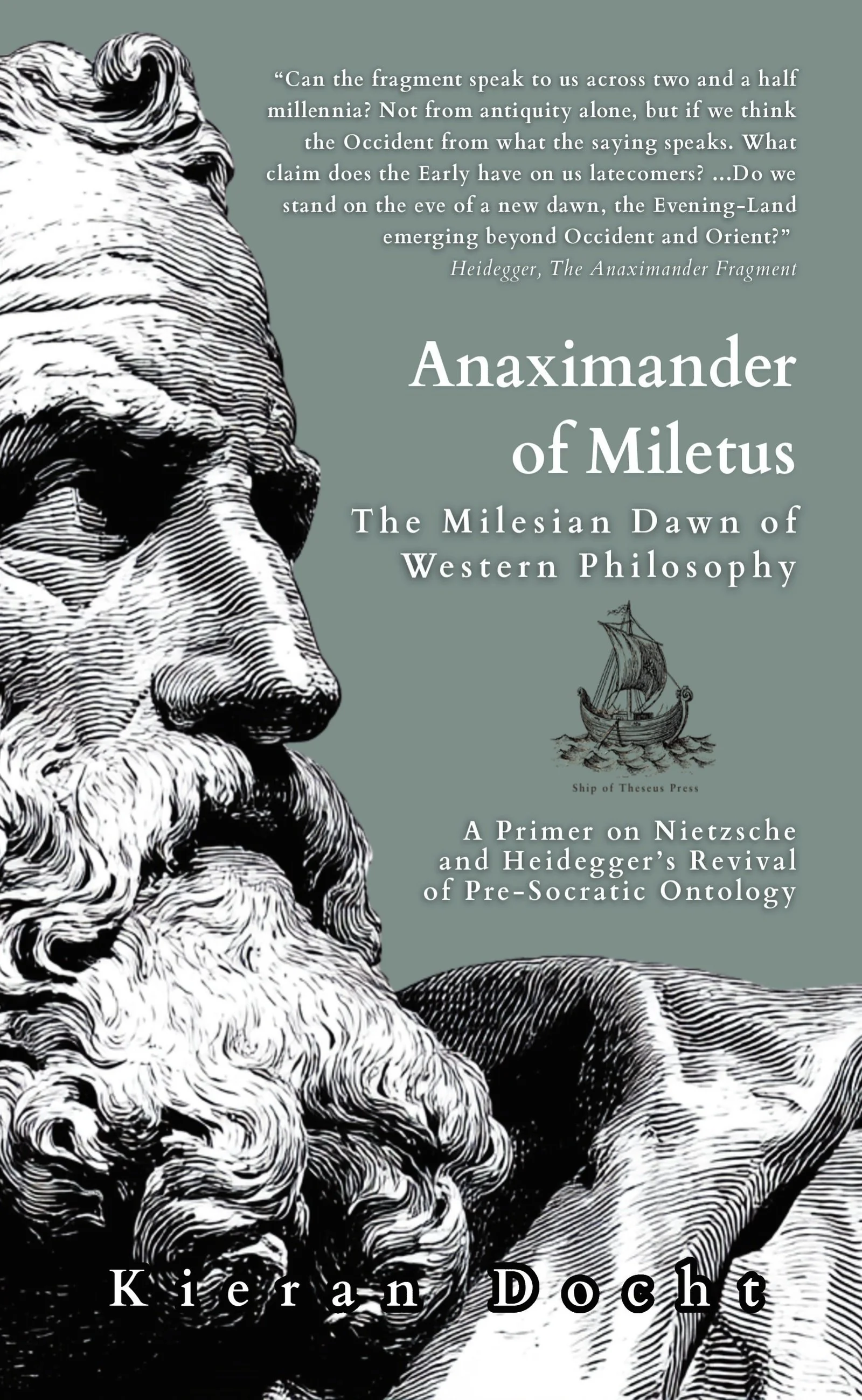
Anaximander’s vision, preserved in philosophy's oldest surviving fragment, went largely unexamined until Nietzsche and Heidegger recognized in this pre-Socratic thinker something the entire Western tradition had overlooked.
Both philosophers returned to Anaximander at pivotal moments, seeking not historical reconstruction but philosophical renewal. For Heidegger, engaging Anaximander meant "preparing for a new dawn by experiencing the oldest dawn of the West." For Nietzsche, the Milesian represented a pre-Socratic confrontation with existence as tragic rather than teleological. Each saw in Anaximander's fragment—which speaks of beings paying "penalty and retribution to each other for their injustice according to the assessment of Time"—a mode of thinking that later philosophy had systematically repressed.
Nietzsche found in Anaximander a cosmos governed by judicial economy, where individuation itself constitutes transgression. To become something determinate means committing an offense requiring expiation through dissolution—a tragic wisdom that Socratic philosophy would work to suppress.
Heidegger's reading went deeper still: Anaximander articulated the ontological difference before metaphysics emerged to conceal it. The fragment's vocabulary disclosed not primitive ethics but the primordial structure of presencing itself. Beings emerge from the boundless (Apeiron) only to bear the burden of their own existence, their persistence a metaphysical trespass demanding return to the indeterminate.
This book traces why both thinkers found in Anaximander's cosmology a resource for challenging the metaphysical assumptions governing Western thought since Socrates. His vision of a cosmos maintained through perpetual dissolution offered a way to think existence beyond progress, purpose, and permanence. The Milesian's economy of debt and repayment, with Time as cosmic enforcer, became for Nietzsche and Heidegger a lost beginning that philosophy needed to recover.
The study explores central questions that connect Anaximander to continental philosophy: the violence of individuation, the relationship between the determinate and indeterminate, the temporal structure of finite existence, and whether Being can be thought beyond beings.