

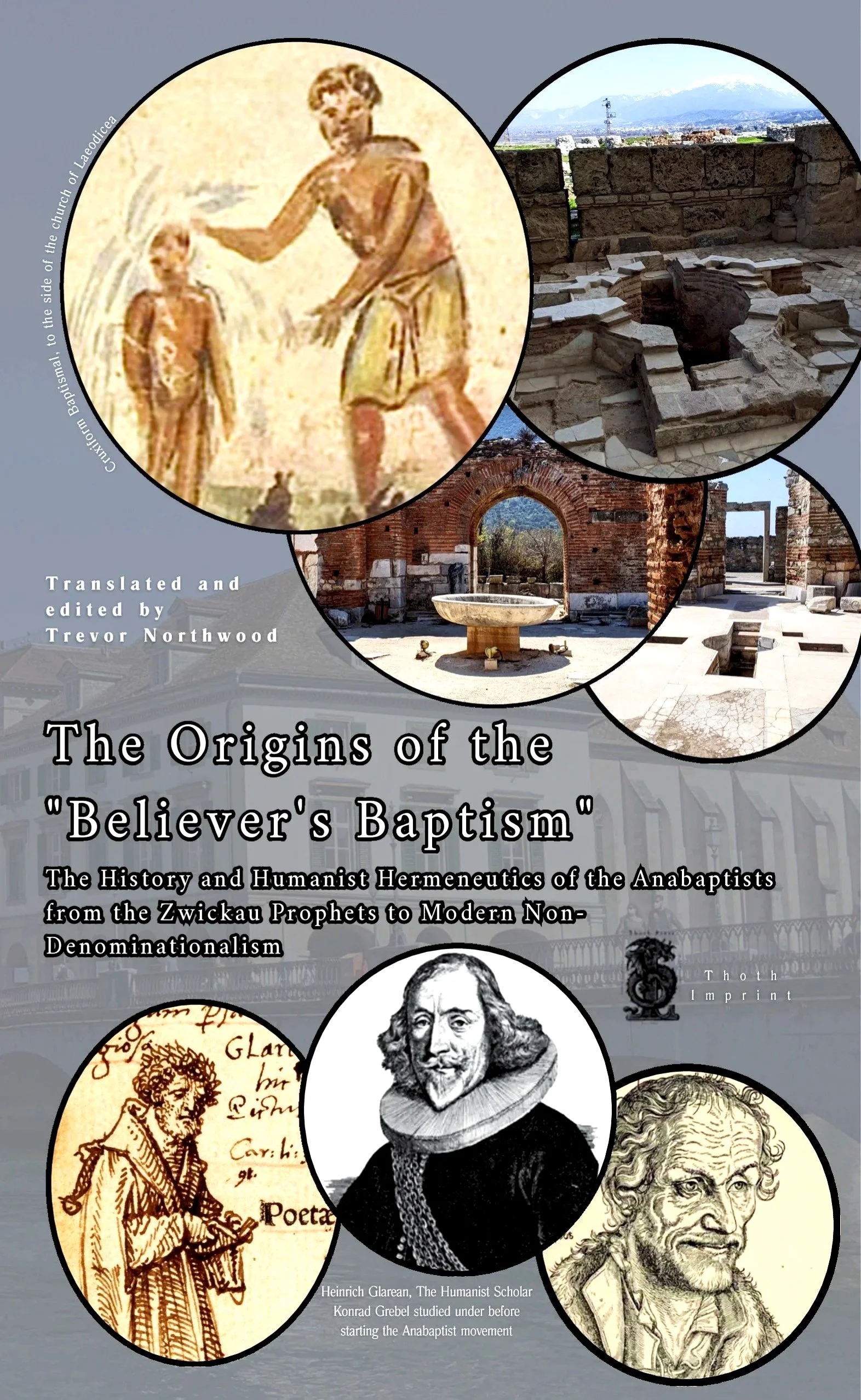
The History and Humanist Hermeneutics of the Swiss Anabaptist Movement from the Zwickau Prophets to Modern Non-Denominationalism
A primary-source examination of the Swiss Anabaptist movement, from the self-described "Zwickau Prophets" proto-Anabaptists to the Humanist Conrad Grebel, who developed the modern idea of "Believer's Baptism" and founded the entire Anabaptist movement, to the violent overthrow of Münster by his followers, and the subsequent expansion and fragmentation of the movement across the Protestant world — through the English Separatists and Proto-Baptist movements of the late sixteenth century, the emergence of the Particular Baptists, Baptist survival through persecution, the First Great Awakening, the Fundamentalist-Modernist controversy, the Neo-Evangelical era and Charismatic influence, the Conservative Resurgence, and finally the Neo-Calvinist Reformed movement and its subsequent rapid secularization in the present day.
This edition includes, as appendices, unabridged translations of Melanchthon's letter from Wittenberg on the three men from Zwickau and the Zwickau dissensions; Spalatin's protocollar records regarding the Zwickau Prophets at Wittenberg (January 1522); Luther's 1525 Against the Heavenly Prophets, Concerning Images and the Sacrament, in which he condemns the Anabaptist sect as radical, violent, and dangerous to civilization and details their fabricated martyrdom; the letter from the Augustinian monks Lorenz Schlamau, Matthäus Beskau, Otto Beckmann, Sebastian Küchemeister, Georg Einer, Johann Rachais, and Johann Volmar in answer to the mission of Christian Beyer (Wittenberg, December 14, 1521), addressed to Illustrissimo ac Sapientissimo Principi, Domino Friderico, Saxoniae Duci, Electori, Lucernae Israel, Domino suo clementissimo; Luther's 1529 On the Baptism of Children; and Luther's 1529 Large Catechism.
The Humanist philosopher Conrad Grebel, called "The Father of the Anabaptists," is the first intellectual in Christian history to argue that Christian families should not baptize their children, outside of Tertullian's heretical Donatist arguments. Conrad Grebel was a Humanist Philosopher, who studied under the famous Humanist Heinrich Glarean, who later became a Minister and interpreted the Bible through Humanism, resulting in the Anabaptist "Believer's Baptism" and a rejection of the infant baptism practiced since the time of the apostles.
Using previously untranslated letters and documents from Grebel, Melanchthon, Luther, Calvin, Georg Spalatin, Müntzer, and other core players, this work maps how the early Swiss Anabaptist movement was deeply intertwined with Anti-Trinitarianism and frequently resorted to violence, sparking persecution from the core Reformation. The 1521 Swiss Zwinglian Reformation is treated in detail as the immediate context of violence and chaos out of which the Anabaptist movement emerged, followed by a close examination of the Zwickau Prophets — Claus Storch, Thomas Drechsel, and Marcus Thome — whose proto-Anabaptist spiritualism preceded and overlapped with Grebel's more formally articulated program. The Münster Rebellion and the semi-martyrdom of the seedling Anabaptist religion, the core Reformation's response, the rise of the Hutterites, and the expansion of the Swiss Brethren to America are all treated in turn, before the work traces the direct line from Zwingli through the Schleitheim Articles to the modern "Simply Christian" non-denominational movement.
The surviving correspondence of Conrad Grebel spans eight letters written between September 1517 and May 1525, a period that traces his transformation from an unremarkable humanist student in Vienna to the leading figure of the nascent Swiss Anabaptist movement in Zurich. The earliest letters are conventional exercises in Ciceronian epistolary style, filled with classical allusions, requests for books, complaints about money, and the playful self-deprecation expected of a young man seeking the patronage of established scholars like Ulrich Zwingli and Oswald Myconius. By late 1522, the tone has shifted toward anti-clerical polemic, and by December 1523, Grebel has broken decisively with Zwingli over the Zurich council's decision to manage the pace of liturgical reform, issuing a formal "axiom" that anyone who regards Zwingli as a legitimate pastor "thinks, believes, and says impiously." The correspondence reaches its theological climax in the programmatic letter to Thomas Muntzer of 5 September 1524, co-signed by several future Anabaptists, which lays out a regulative biblicism demanding that worship be restricted to what is explicitly commanded in the New Testament, rejecting infant baptism, congregational singing, and any eucharistic theology beyond a bare memorialism, while simultaneously rebuking Muntzer's advocacy of armed resistance and insisting on the absolute non-violence of the gathered church. The final letter, written to his brother-in-law Joachim Vadian in May 1525, is a plea for Vadian to abandon Zwingli's "bloody party" and the sin of usury, invoking Psalm 15, Ezekiel 18, and a papal decretal in the same breath, and offering Grebel's own life as surety for the truth of the Anabaptist cause. Read together, the letters document with unusual immediacy the process by which a humanist education, a volatile temperament, genuine moral conviction, and a confidence in the plain sense of Scripture that outstripped the linguistic tools available to sustain it combined to produce a movement whose consequences, from the pacifist separatism of the Swiss Brethren to the theocratic catastrophe at Munster a decade later, Grebel himself could neither foresee nor control.
The linguistic limitations of the early Anabaptist leaders compounded their historical ignorance and prevented them from engaging with the Greek text of the New Testament at the level of philological precision that would have undermined their own exegetical claims. While Felix Manz had studied Hebrew and could read the Old Testament in its original language, neither he nor Grebel possessed advanced training in Koine Greek. Grebel's education in Vienna and Paris had exposed him to humanist methods, but he never achieved the fluency in Greek that would have allowed him to parse the grammatical nuances of baptismal passages or to compare different manuscript traditions. This deficiency meant that the radicals relied primarily on Latin translations, particularly the Vulgate, and on the German translations beginning to circulate through Zwingli's own work and Luther's Bible.
The first substantive chapter offers an exegesis of the Anabaptist claim that the New Testament does not record infant baptisms — a believable claim at the time because the early Anabaptist leaders only had the Bible in German. Examined in the Greek and Hebrew, the New Testament explicitly records the baptism of entire families. The household baptisms in Acts 16:15 (Lydia), Acts 16:31–34 (the Philippian jailer), and 1 Corinthians 1:16 and 16:15 (Stephanas) use Greek terminology — οἶκος, πάντες, πανοικεί — that the Septuagint employs in contexts explicitly including eight-day-old infants. The command in Genesis 17:12 to circumcise male infants on the eighth day, παιδίον ὀκταημερον in the Septuagint, establishes that the Old Covenant sign was applied to those utterly incapable of faith, understanding, or consent, based solely on their incorporation into the household of Abraham. When Colossians 2:11–12 explicitly connects circumcision and baptism, Paul identifies baptism as the New Covenant equivalent of circumcision, the rite that marks entry into the covenant people. The Anabaptist argument that baptism requires conscious, articulated faith from the recipient collapses against this typological relationship: if the Old Covenant sign could be applied to eight-day-old infants who possessed no capacity for intellectual assent, then the New Covenant sign can likewise be applied to infants based on the faith of their parents and their incorporation into the household of faith. The entire concept of "Believer's Baptism" breaks the fundamental covenant theology of the Bible. The work also addresses the claim that there is an "escape hatch of hermeneutics" that preserves the circular logic of sola scriptura, examining how the Anabaptist interpretive method ultimately proves self-defeating.
The archaeological and pre-Christian evidence is then treated at length. To understand the 1521 Anabaptist sect, one must go back to pre-Christian Essene baptism and understand how the Apostles understood the baptism of John versus that of Christ. The Jewish practice of ritual immersion in the Second Temple period was far broader and more theologically developed than a simple reading of the New Testament would suggest, stretching across priestly law, pseudepigraphical literature, diaspora philosophy, and sectarian community practice. Philo distinguished carefully between washings and sprinklings and understood water as an instrument of divine sanctification. Josephus described full-body immersion as the standard application of Levitical purity requirements. The Testament of Levi and the book of Jubilees extended purification requirements back to the patriarchs. The Jewish Sibylline Oracles connected bodily washing in flowing rivers to repentance and divine forgiveness in terms that anticipate John the Baptist's preaching almost verbatim. The Essene community at Qumran, whose mikva'ot survive archaeologically and whose Community Rule and Damascus Document legislate the conditions of valid immersion in considerable technical detail, developed a theology in which water purification was both physically necessary and morally insufficient without prior repentance — a pattern structurally identical to what the Didache and Hippolytus would later describe for Christian baptism and the Eucharist. Since the Essene community included families rather than adult men alone, and since the rabbinical principle of zakhin le-adam shelo befanav permitted a parent to confer a covenant benefit on a child incapable of personal consent, the later Christian practice of infant baptism drew on both the Essene communal model and the rabbinic legal framework rather than departing from Jewish precedent.
The testimony of the first Christian writers is then surveyed chronologically: Irenaeus of Lyons, a disciple of Polycarp who was himself a disciple of John, whose Against Heresies provides apostolic witness; the Didache; Origen of Alexandria; the letters of Cyprian of Carthage; Hippolytus of Rome's Apostolic Tradition; Justin Martyr; Augustine and the later early church fathers; and Johannes Chrysostomus' baptismal catechesis. The work also addresses and dismantles the myth that Constantine forced child baptism for tax or financial purposes. Out of the thin early archaeological remains of the first five centuries, geographically dispersed churches — from the St. Thomas Nasrani to the Ethiopians, Copts, Antiochians, and the Western churches — are seen to share the same baptismal practice. No Roman emperor or Pope ever had control over the ancient Ethiopian, Coptic, Antiochian, or Nasrani churches, which makes any claim of centrally imposed innovation impossible to sustain.
This book then traces the Humanist origins of the new Anabaptist sect, examining the theology of Conrad Grebel and the Swiss Brethren, the Zwickau Prophets, the Münster Rebellion, and the core Reformation's response in detail, before following the thread forward through the Hutterites, the Swiss Brethren's expansion to America, and the long arc from Zwickau to the Second Great Awakening, the merging of Calvinism into Baptist Theology, and the modern "Simply Christian" movement of "non-denominationalism". The conclusion addresses the anachronistic history of the Anabaptists as represented by Harold S. Bender, the social history of a movement that was not a mass restoration, the distinct but related relationship between Anabaptists and Baptists as two independent religions sharing one practice for different reasons, and the humanist formation of the movement's founders. The concluding theological chapters treat the biblical-apostolic theology of baptism, Anabaptism as a species of Gnostic dualism, the dueling metaphysical models of Humanism and Logos, "Believer's Baptism" as a manifestation of the heresy of Gnosticism, the baptism of John as a baptism of repentance unto preparation, Christ's baptism in the Jordan as the sanctification of waters and Theophanic revelation, the institution of Christian baptism in the post-Resurrection command, and the relationship between John's baptism and Christian baptism as typology and fulfillment.
The universal practice of infant baptism in every region of the Christian world by the mid-third century, combined with explicit patristic testimony attributing it to apostolic tradition, makes the theory that it was invented historically implausible to the point of impossibility. Origen states that the church received the tradition of baptizing infants from the apostles. Cyprian of Carthage debates not whether infants should be baptized but how soon after birth, a discussion that presupposes infant baptism itself was uncontroversial and universally practiced. Augustine appeals to the universal practice of infant baptism as evidence for original sin, and even the Pelagians, who had theological reasons to resist the conclusion, did not deny that the church baptized infants. It is not theologically defensible to argue that all Christians throughout all time were always wrong from the age of the apostles until a small circle of Swiss Humanists in the early sixteenth century somehow restored an original apostolic Christianity that had simply never existed. The Anabaptist understanding of "Believer's Baptism" was not recovered from the apostles; it was constructed by a single Humanist philosopher named Conrad Grebel. The burden of proof rests entirely on those who claim infant baptism was invented, to explain how such an invention could have occurred universally and without controversy, and why no Christian community anywhere preserved the supposedly apostolic practice of baptizing only adults capable of articulating personal faith.